

Operations
Run creator tax operations that hold up to scrutiny
A practical guide to running creator tax operations: the workflows, data and checks that keep records, invoicing and reporting accurate and defensible.
What to take away
- Decide who owns each step of the tax cycle, from income capture to filing, and write it down.
- Keep source records that reconcile to bank and platform statements, not just to a spreadsheet total.
- Treat invoicing, VAT treatment and expense evidence as one connected process, not separate chores.
- Review the operation against a fixed checklist before each deadline.
- If your circumstances are complex, take advice from a qualified adviser. This guide is general information only.
What creator tax operations produce
Creator tax is not a single event. It is a year-round operation that produces numbers someone else may later question. HMRC can ask how a figure was built, and a bank total alone rarely answers that.
A creator earning from several platforms, brand deals and affiliate income faces a reconciliation problem. Each source pays on its own schedule, uses its own reporting period and may deduct fees before paying you.
Good operations make that manageable. They also reduce the panic that arrives in January, when the filing window is short and the evidence is scattered.
There is a commercial reason as well. Brands running procurement checks may ask for proof of trading activity before signing a larger deal. An operation that produces clean records makes those conversations shorter.
Capture, classify, reconcile, report
Start with a simple model: capture, classify, reconcile, report. Each stage produces a defined output.
Four stages of the operating model
- Capture: raw records, source documents
- Classify: coded ledger, tax treatment
- Reconcile: list of unexplained differences
- Report: filed figures, working paper trail
The capture stage collects raw records: platform statements, invoices raised, bank credits and receipts. The output is a complete set of source documents for the period.
The classify stage assigns each item a category and a tax treatment. The output is a coded ledger that someone else could follow. Use accounting software such as Xero or FreeAgent, or a spreadsheet template with a monthly tab.
The reconcile stage compares the ledger to bank and platform statements. The output is a list of unexplained differences, each with an explanation.
The report stage produces the figures for Self Assessment, VAT returns or company accounts. The output is a filed position with a working paper trail.
If you trade through a limited company, the report stage also includes annual accounts and a confirmation statement filed with Companies House, and Corporation Tax returns to HMRC.
Roles and ownership
Small creators often do every stage themselves. That works until volume grows, and then errors cluster in the handover points.
Assign a named owner to each stage even if that person is you. Write the name in the process document. When a step is missed, you will know where to look.
Separate the person who prepares figures from the person who checks them where possible. If you work alone, build a delay between preparation and review so you approach the numbers fresh.
For a fuller breakdown of who does what, see creator tax team roles: data and sources, which maps responsibilities across a small team.
Name a deputy for each stage as well as an owner. Holidays and illness are the usual reason a month gets missed, and a deputy turns that into a handover rather than a gap.
Ownership also carries decision rights. Whoever classifies a payment decides its treatment.
Data sources and records
Your records should let you rebuild any reported figure from source. That means keeping platform statements, invoices, contracts and bank records together.
Platform statements matter because gross and net differ. A platform may report gross earnings, deduct commission, then pay net. Your income figure depends on which number you use and why.
For example, a platform statement shows gross earnings of £1,200.00, commission of £240.00 and net payable of £960.00. Your bank receives £960.00 on 12 March.
Enter income of £1,200.00 and platform fees of £240.00 in the ledger, then match the net £960.00 to the bank credit. The £240.00 difference is explained by the commission line, so the reconciliation clears.
Keep the original statement files, not just screenshots. Store them where you can find them by period and platform.
Agree a file naming rule and keep to it: period, platform, document type. A folder that sorts itself by name saves hours when a query arrives two years later. Use a file name such as 2025-03_YouTube_statement.pdf or 2025-03_BrandX_invoice.pdf.
HMRC's guidance for agents sets out how records and client authority are handled in practice. The Tax Agent's Handbook is useful even if you are not an agent, because it shows what a reviewer expects to see.
Registration and deadlines
Self Assessment registration is the first operational milestone. If you are newly self-employed, register using form SA1 by 5 October after the tax year in which you started. HMRC then issues your Unique Taxpayer Reference (UTR). The main return is form SA100, with self-employment details on form SA103. The online filing and payment deadline is 31 January after the tax year end. Paper returns are due by 31 October. Payments on account are due on 31 January and 31 July. HMRC normally requires payments on account if your previous year's tax bill was above the payment on account threshold and too little was collected at source. Class 4 National Insurance is worked out through Self Assessment. Class 2 is no longer generally required for most self-employed people. If your income is low, the trading allowance may mean you do not need to register or may reduce your taxable profit. Check HMRC's current rates and thresholds for the trading allowance, National Insurance and payments on account.
Deadlines and internal dates
- Registrationregister early, before filing
- Internal filinga fortnight ahead of statutory
- Payment on accountin the one calendar
- VAT periodstracked in the same calendar
HMRC has improved the registration service for the self-employed, as described in its update on the improved Self Assessment registration service. Read it before you assume the old process still applies.
Put every deadline in one calendar: registration, payment on account, filing and any VAT periods. Share that calendar with anyone who helps you.
Work backwards from each deadline to set an internal date. An internal filing date of 17 January for the 31 January online deadline leaves room for a missing statement or a late query.
Invoicing and payment terms
Invoicing is where tax operations meet cash flow. An invoice that is late or unclear delays payment and complicates your records.
Agree payment terms in the contract, not in a follow-up email. State the amount, the currency, the due date and what the fee covers.
If a brand asks you to invoice through a platform, check who issues the final tax document. The platform may report the payment, which affects how you reconcile it.
Keep a single invoice numbering sequence. Gaps and duplicates are the easiest things for a reviewer to spot.
Late payment is an operational problem as much as a cash one. A short credit control routine, with a reminder a week before the due date and a follow-up on it, keeps the ledger predictable. For commercial debts, the Late Payment of Commercial Debts (Interest) Act 1998 allows you to charge statutory interest and a fixed sum for late payment.
Record the exchange rate you used for any invoice in a foreign currency, and record where the rate came from. Without that record, the sterling figure cannot be checked later.
VAT and platform fees
VAT treatment depends on your turnover, your status and what you supply. Do not assume platform commission is irrelevant to your VAT position.
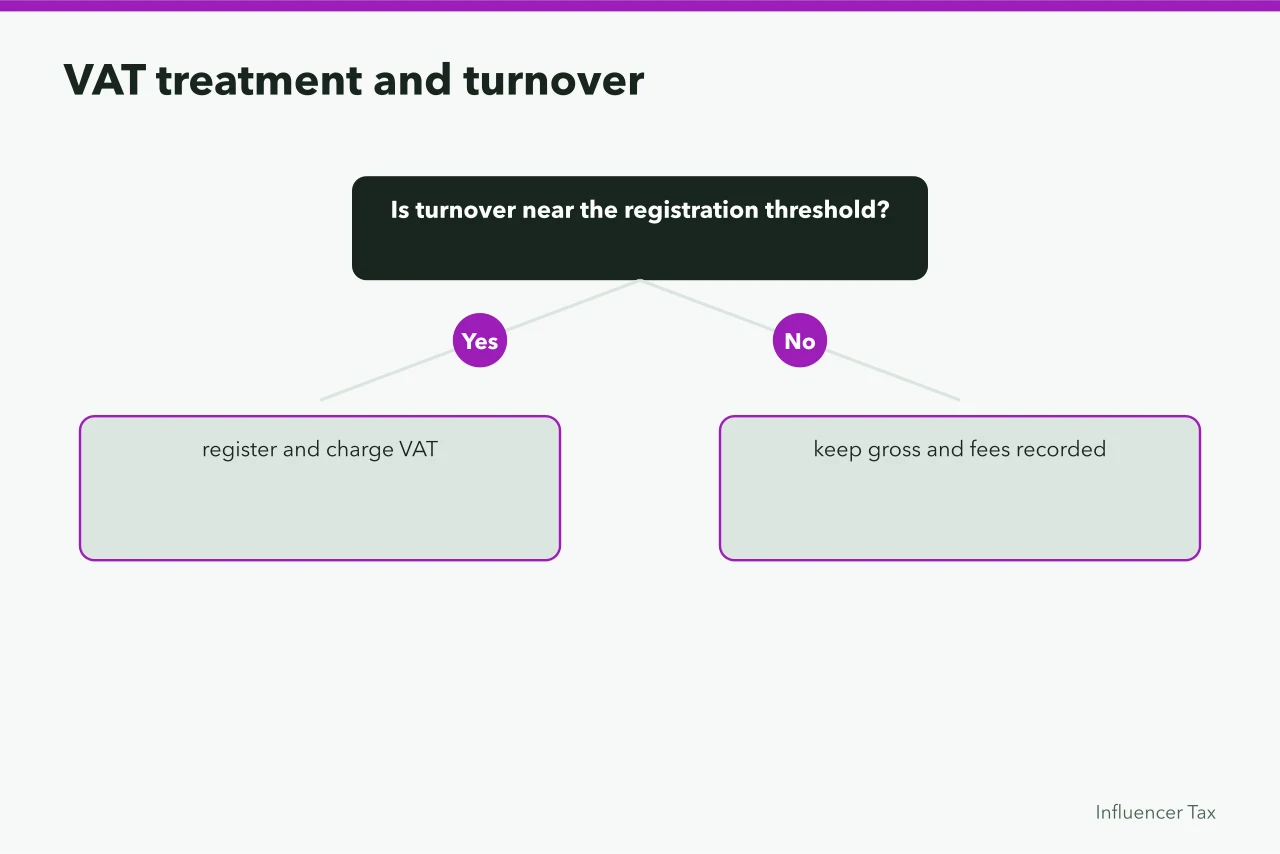
Record gross income and fees separately so you can show the calculation. If you are not VAT registered, still keep the figures, because registration can become necessary as turnover grows.
The current VAT registration threshold is £90,000. Monitor turnover against it monthly rather than annually. A rolling twelve-month check catches a breach early, while there is still time to act.
For example, a rolling 12-month turnover to 30 June of £88,000 plus July sales of £3,500 gives £91,500, above the £90,000 threshold. You must register within 30 days of 31 July, and registration takes effect from 1 September.
For digital services and cross-border supplies, place of supply rules matter. Take advice if you sell to consumers in other countries. VAT Notice 700 is the general guide, and VAT Notice 700/1 covers registration. Once registered, you file a VAT100 return through Making Tax Digital for VAT (MTD for VAT). A valid VAT invoice must show your name, address and VAT number; the customer's name and address; a unique invoice number; the date; a description of the supply; the VAT rate and amount; and the net and gross totals.
Expenses and evidence
An expense needs a business purpose and evidence. A bank payment alone shows money left, not why.
Keep receipts at the point of purchase. Reconstructing them months later is slow and produces weaker records.
For equipment, software and home office costs, write a short explanation of the business use. That explanation is often what makes the claim defensible.
Where a cost is partly private, apportion it on a stated basis and keep the calculation. The basis matters less than being able to repeat it consistently.
If you use a mixed personal and business account, mark business transactions as they happen. A monthly reconciliation turns a messy account into a usable record.
Consumer law and disclosure
Influencer marketing sits inside consumer protection law. The Consumer Protection from Unfair Trading Regulations 2008 set the framework for misleading commercial practices, which is why paid partnerships must be disclosed clearly.
The CAP Code, enforced by the Advertising Standards Authority (ASA), sets the rules for influencer ads, and the Competition and Markets Authority (CMA) publishes guidance on disclosure. Keep the agreed wording and the published post together so you can show what was agreed and what appeared.
Disclosure is not only a marketing issue. It affects contracts, invoices and the evidence trail for a campaign.
Keep a copy of the agreed disclosure wording and the published post. If a campaign is later queried, you can show what was agreed and what appeared.
Platform reporting
Under HMRC's digital platform reporting rules, platforms must report sellers' income to HMRC. The UK rules follow the OECD model rules and are separate from the EU's DAC7 directive. Platforms report income in different ways and at different times, so check whether they report gross or net and when.
Check whether the platform reports gross or net, and when. Then align your own records to that basis so the two can be compared.
Where a platform issues a tax form, keep it with the matching statement. That pairing is the fastest way to explain a difference.
Record each platform's reporting basis, currency and payment date in your platform register. A new platform gets a new line.
Data protection
Creator operations collect personal data: audience lists, sponsor contacts, contractor details. That brings obligations under data protection law.
If you suffer a personal data breach, you may need to report it. The ICO explains when and how in its guidance on reporting a data breach.
You also need a lawful basis under UK GDPR for processing personal data, such as consent or legitimate interests. Most organisations that process personal data must pay the ICO's data protection fee unless an exemption applies. If someone makes a subject access request, you must respond within the statutory time limit.
Keep access to financial and audience data limited. A shared login with no record of who used it weakens both security and your audit trail.
A simple register helps: the systems that hold personal data, who can reach them and why. That register is the starting point for a subject request or an incident.
Quality checklist
A checklist turns good intentions into repeatable checks. Run it before every filing, not only at year end.
Pre-filing quality checklist
- All income sources listed
- Each reconciled to a statement
- Expenses evidenced
- Invoices numbered without gaps
- VAT position confirmed
Include: all income sources listed, including platform statements and brand deals; each reconciled to a bank or platform statement; expenses evidenced with receipts and a business purpose; invoices numbered without gaps; the VAT position confirmed against the registration threshold; Self Assessment forms SA100 and SA103 checked; and payments on account reviewed. Record the date you ran the check and what you fixed.
Our creator tax quality checklist in England turns those items into a working list you can adapt.
Record the date you ran the check and what you fixed. That record shows the process operated, not just that it existed on paper.
Reviews and comparisons
Once a year, compare what you expected to what happened. Look at income by source, effective tax rate and the time each stage took.
Comparison is how you spot a platform that pays late, a category that is consistently mis-coded, or a month that always creates a backlog.
Compare like with like. A quarter with a launch in it will not resemble a quiet one, so note the events that explain a difference before drawing conclusions.
Keep the measures stable between reviews. Redefining a category halfway through the year makes any year-on-year comparison meaningless.
For methods that make those comparisons meaningful, see creator tax: reviews and comparison methods for 2027, which covers period choice and like-for-like measures.
Write the review as a short memo with three findings. A memo listing ten problems will not be acted on.
Circulate that memo to anyone who owns a stage.
Launch and review points
A new income stream changes your operation. Treat the first payment from a new platform as a trigger to review capture and classification.
Before that first payment arrives, decide how it will be captured and coded, and who will check it. Decisions made in advance are easier to apply consistently.
An income stream that starts part way through the year also changes your estimate for payments on account, so revisit that figure once the run rate is clear.
Our guide to a creator tax launch review: data and sources sets out what to check when a stream goes live.
Review points should be scheduled, not reactive. Put two dates in the calendar: one mid-year, one before filing.
The same applies when a stream ends. A closed platform or a finished contract needs a final reconciliation so the ledger does not carry an open balance.
Monthly close steps
A practical workflow runs monthly, not annually. A monthly close keeps the backlog small and the records fresh.
The monthly close
- Capture statements
- Code transactions
- Reconcile to bank
- Note differences
- File working papers by period
At the close, capture statements, code transactions, reconcile to bank, and explain differences. Then file the working papers by period.
Set a fixed day for the close, such as the fifth working day of the month, and treat it as an appointment. Consistency matters more than the exact date.
For a step-by-step sequence you can follow, see our creator tax operating workflow in England.
Keep the workflow short enough to finish in one sitting. A process that takes three evenings will be abandoned.
Glossary
- Gross income
- total earned before platform or agency fees.
- Net income
- amount received after deductions.
- Reconciliation
- matching records to statements and explaining differences.
- Working papers
- the evidence behind a reported figure.
- Payment on account
- advance payments towards the next tax bill.
This guide is general information only. Tax and legal positions vary, so take advice from a qualified adviser before acting.
Common questions
Do I need to register for Self Assessment if I only earn a little from content?
It depends on your total income and whether it is taxable. HMRC's registration guidance is the starting point, and a qualified adviser can confirm your position.
Can I use platform statements as my only income records?
They are a good source, but keep invoices, contracts and bank records alongside them. Together they let you rebuild any figure you report.
How long should I keep creator tax records?
For Self Assessment, keep records for at least 5 years after the 31 January filing deadline for the tax year. For VAT, keep records for 6 years. For company accounts, keep records for 6 years from the end of the financial year.
What if I get the VAT treatment wrong?
Correct it as soon as you identify it and record what changed. Complex cases should go to a qualified adviser.
In this guide
- Creator taxes: an operating workflow with clear approvalsCreator taxes: a step-by-step operating workflow for UK creators, with HMRC Self Assessment deadlines, set-aside, approvals and record keeping.
- Run a creator tax quality checklist before every filingA creator tax quality checklist for England-based creators: the records, invoicing, ad disclosure and sign-off checks to run before any return or claim goes out.
- What a creator tax team roles plan means for solo UK creatorsA look at which creator tax team roles a solo UK creator should fill, buy in or leave, with a decision table and the sources that support each choice.
- How to set creator tax service standards without weekly chasingHow to set creator tax service standards in England: reply windows, evidence trails and quarterly review points, with a labelled pound example.
- Creator taxes: how to check a launch claim before you buyHow to check a creator taxes launch claim: HMRC's software list, Companies House, HMRC's VAT checker, the ICO fee payers register and ASA rulings.