

Foundations
Part of Creator tax foundations that self-employed creators need to know
What are the creator tax commercial opportunities in England?
Creator tax commercial opportunities in England: the recurring service lines UK accountants can sell in 2026-27, plus the compliance rules that shape each one.
What to take away
- HMRC's Creative Industries Statistics 2025 put creative industry GVA at £124.6 billion in 2023, 5.6% of UK GVA.
- The opportunity is recurring service lines, not one-off filings: bookkeeping, Making Tax Digital support, VAT and invoicing, payroll for staff, and data protection advice.
- Each line needs a compliance anchorstaff expenses rules, an ICO lawful basis, and ASA advertising guidance.
- Thin one-off advisory work competes on price; recurring compliance work competes on trust.
- The full market map sits in the Creator taxEngland market guide for 2027, which sets out demand, definitions and the MTD for Income Tax deadlines in April 2026 and April 2027.
Where the money comes from
A creator business pays repeatedly for three things: clean books, handled filings, and compliant platform and brand relationships. Each is a service line an accountant can productise.
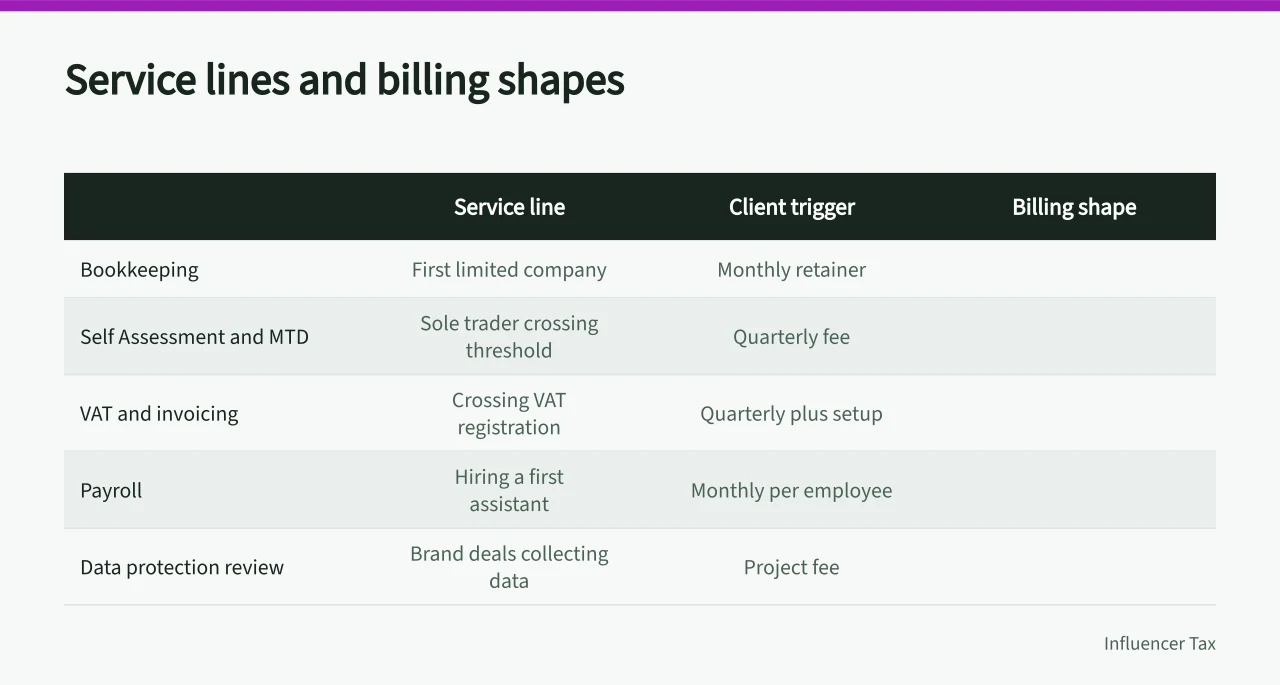
Service lines compared
Client trigger
- Bookkeeping
- First limited company
- Self Assessment and MTD
- Sole trader crossing the threshold
- VAT and invoicing
- Crossing VAT registration
- Payroll
- Hiring a first assistant
- Data protection review
- Brand deals collecting audience data
Billing shape
- Bookkeeping
- Monthly retainer
- Self Assessment and MTD
- Quarterly fee
- VAT and invoicing
- Quarterly plus setup
- Payroll
- Monthly per employee
- Data protection review
- Project fee
Shapes are illustrative. No published rate card exists. Price by transaction volume, platforms, VAT and staff. The £400 monthly retainer below is illustrative.
Staff expenses as a service
Creators who hire editors, researchers or assistants create a payroll and expenses workload many handle badly. GOV.UK's staff expenses rules set out when wages, salaries, bonuses and certain employee costs are allowable, and what records are needed.
Data protection advice
Creators running audience lists, competitions or fan communities process personal data. The ICO's lawful basis guidance requires a valid basis before processing, and consent carries specific conditions.
Advertising rules as a wedge
Paid partnerships must be identifiable as advertising. The ASA's advice for businesses explains the CAP Code expectations for labelling and disclosure.
Who buys which service
Sole traders early on mostly need Self Assessment and simple invoicing. Limited company owners need accounts, corporation tax and often VAT. Creators with staff need payroll; those with sponsorship income need compliance reviews.
Match service to client trigger
What stage is the creator business at?
Sole trader early on -> Self Assessment and simple invoicing
Limited company owner -> Accounts, corporation tax, often VAT
Building the offer
The Creator tax market entry checklist in England covers practical setup, from engagement letters to software. Use it once the target lines are chosen.
Engagement letters need clauses on scope, fee basis, client responsibilities for records, liability and termination. Use Xero, QuickBooks or FreeAgent for bookkeeping, and BrightPay or Xero Payroll for staff. Create chart-of-accounts categories for platform payouts (YouTube, TikTok) and affiliate income (Amazon Associates, Awin). Onboarding checklist: collect UTR, company number, VAT number, platform statements, brand contracts, and staff details.
Specialise by creator type: video, audio, written or live. Each has different income timing and platform reporting, and specialists can charge more for knowing the cashflow pattern.
Risks and limits
Creator tax is not a separate regime. General UK tax law applies, and individual cases need a qualified adviser. HMRC's platform reporting rules since January 2024 require platforms to report sellers with more than 30 transactions or €2,000 a year.
Sell process rather than certainty: clean records, documented positions, timely filings. That holds up when HMRC asks questions.
Common questions
Is creator tax advice a regulated activity?
Not as a separate category. Accountants offering creator services work under the same UK rules as any other client work, and providing tax services for reward may require anti-money laundering supervision with HMRC.
Can I offer these services to creators outside England?
Yes, but the rules differ. Scotland has its own income tax bands and Wales has different land transaction tax rules. This article covers England only.
What should I charge for a creator bookkeeping retainer?
There is no published rate. Price by transaction volume, software and number of platforms. For example, a £400 monthly retainer suits a simple sole trader and is low for a limited company with staff and VAT.
Do I need separate software for creator clients?
No. Standard accounting software works. Platform payouts, brand deals and affiliate income need their own chart-of-accounts categories so the year-end numbers mean something.